 Veraclimb
Guide · Training structure
What is a grade pyramid?
One picture that shows whether you're actually getting stronger — every send you've logged, stacked by grade.
A grade pyramid is a bar chart of your sends: one row per grade, widest at the bottom. Lots of V2s and V3s form the base; your handful of V5s sit near the top; your single hardest send is the peak. Climbers have sketched these in notebooks for decades because the shape tells you more than the top number does.
How to read yours
- A wide base under a single peak — the classic healthy shape. Your hardest send is supported by volume one and two grades below it. That top grade is real: you didn't luck into it, you climbed into it.
- A spike — one V6 sitting on two V5s and almost nothing below. Usually means you've been projecting at your limit while skipping volume. Impressive, fragile, and often where plateaus and tweaky-finger injuries come from.
- A plateau shape — a wide base that just stops, with nothing above it for months. You're fit at your comfort grade; you've stopped trying things you might fall off.
Using the pyramid to pick your next climb
The pyramid turns "what should I get on today?" into a data question:
- Thin base? Spend a session sending fast, one or two grades down. Volume days build the movement library that hard sends draw from.
- Wide base, no peak? Pick a project one grade above your top row and commit real attempts to it across sessions.
- A rule of thumb many coaches use: before hunting your next top grade, have roughly two sends at the grade below it and four at the grade below that. The exact numbers matter less than the habit of checking.
Pyramid + a movement measure = the full picture
The pyramid tells you what you sent; it can't tell you how you climbed it. Two climbers with identical pyramids can be on completely different trajectories — one flowing through their top grade, one surviving it. That's why Veraclimb pairs the pyramid with a measured smoothness trend from your filmed attempts: the shape says whether the base is there, the number says whether the movement is improving underneath it. (How that measurement works →)
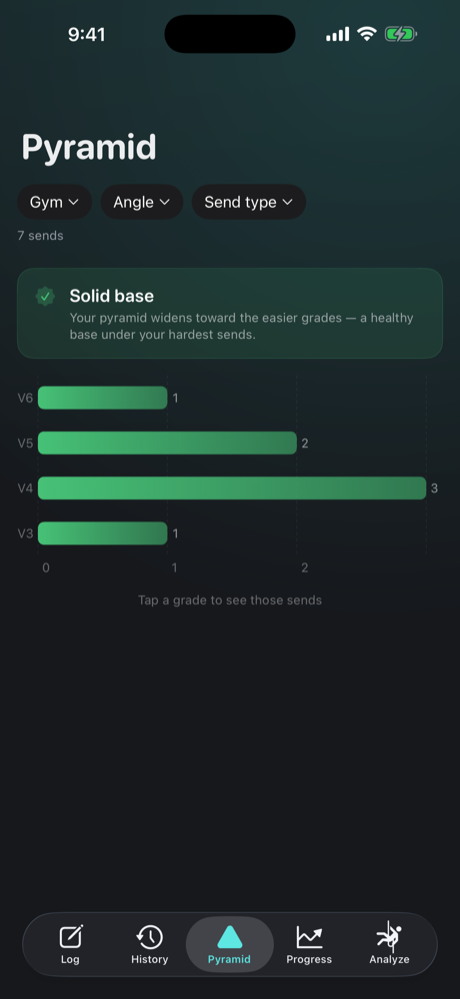
Your pyramid builds itself. Log a send in one tap and Veraclimb keeps the pyramid, the progress charts, and your smoothness trend current — free, no account, on-device. Get Veraclimb →